

Skincare Mistakes To Avoid In Your 40s For A Healthier Complexion
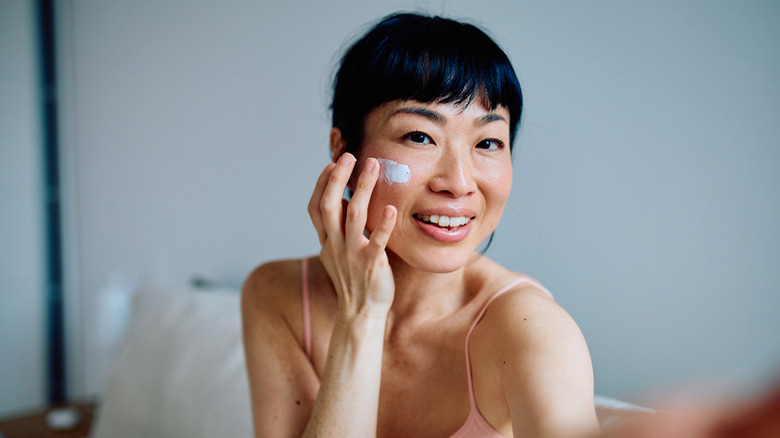
If you've noticed your skin looking dull, uneven, rough, or crepey in your 40s, you're certainly not alone. These are some of the most common complexion changes women notice as they exit their 30s. The good news is that your skin's complexion is influenced by your beauty habits and can be actively improved with the right routine. But here's the thing: It's not just about figuring out everything your skincare routine needs if you're over 40 or splurging on that ridiculously expensive face cream. It's more about stopping the habits you currently engage in that are worsening your skin's complexion.
To understand what we should avoid, Glam spoke exclusively with Dr. Brendan Camp, a board-certified dermatologist of MDCS Dermatology, who walked us through some of the most common skincare mistakes he sees women in their 40s make. One of the most common errors he shared regards a well-known but misunderstood skincare product: sunscreen. "Some people tell me they don't use sunscreen in fall or winter because they have less sun exposure," he says. "The truth is that your skin is exposed to UV radiation on a daily basis, 365 days a year."
Sunscreen prevents dark spots and leathery skin texture, helps maintain an even skin tone, prevents redness and inflammation, and stops your skin from aging prematurely. Additionally, without sunscreen, you risk reversing any improvements made with other habit changes. In fact, using certain active ingredients without sunscreen can cause more harm than good to your skin. To get the most from SPF, start by figuring out how to choose the best sunscreen for your skin and investing in some other sun protection essentials like wide-brimmed hats and sunglasses. With the basics set, you can move on to eliminating other mistakes in your skincare routine.
Not using retinoids carefully can damage your skin in your 40s

Not everyone needs retinoids in their routine, but if you're over 40 and dealing with an unhealthy complexion, they are a major help because they boost cell turnover rate. To be clear, boosting cell turnover rate is a fancy way of saying they encourage older, damaged cells to fall off more quickly so the newer, healthier ones can surface. The real difference between retinoids and retinols is that "retinoid" is an umbrella term that covers multiple vitamin A derivatives, including retinol. However, in the world of skincare marketing, non-prescription skincare products with vitamin A derivatives tend to be referred to as "retinol" or "containing retinol," while retinoids are generally the stronger vitamin A products that need to be prescribed. However, you can buy some lower-strength retinoids like adapalene over-the-counter.
During our exclusive chat with Dr. Brendan Camp, he shared that the most common mistakes he sees concerns the how and the when. "Some patients mistakenly think they can't use retinols or retinoids in the summer because these products make skin more sun-sensitive," he says. "Retinols and retinoids can be used in the summer, but they should be used carefully to avoid redness and sunburns." This means using sunscreen every morning and reapplying after two hours when outdoors.
If you've never used either of these forms of vitamin A, you should start with weaker retinols in serums or moisturizers. However, there are a couple of things to know before using retinol. First off, you'll need to patch test, just like with any other product. Secondly, you shouldn't use retinol with any acids, like AHAs, in the same routine. You should also avoid layering it with benzoyl peroxide and vitamin C , and alternate the nights you apply these products instead.
Over-exfoliating does more harm than good, especially in your 40s
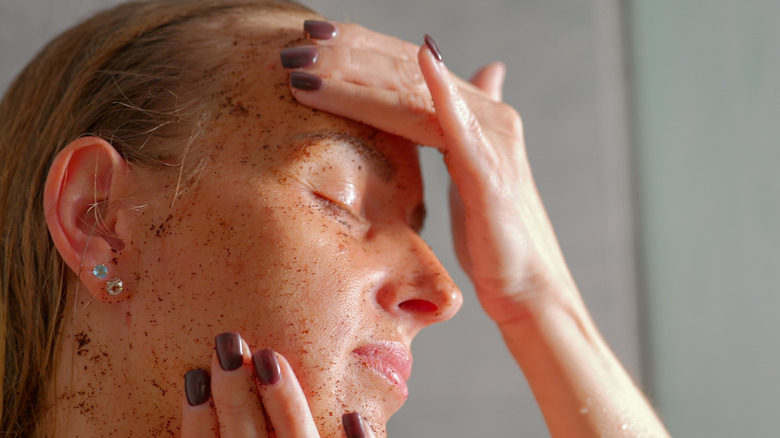
Exfoliating your skin is one of the best ways to even out your skin tone and complexion, but if you're in your 40s, you could damage your skin with the wrong exfoliation methods. Exfoliation basically means removing the dead skin cells that have accumulated on the top of the skin, and if you do this too frequently, you risk irritation, redness, dryness, flakiness, and even damaging your skin's barrier. None of these make for a good skin complexion. When it comes to exfoliation, there are two major types: physical and chemical. And while neither of these is bad, there are some drawbacks to both, so it's important to know which your skin needs and how to do it right.
One of the major changes that may happen to your skin in your 40s is that it becomes more sensitive and reactive. If you have sensitive skin, you're likely better off choosing chemical exfoliants over physical ones to reduce the chance of inflammation. Some of the best chemical exfoliants are Alpha Hydroxy Acids (AHAs) like lactic acid or enzyme exfoliants. It's also important to keep track of how often you exfoliate, limiting it to two to three times a week. As always, patch test first and track how your skin reacts before fully diving in.
That said, both kinds of exfoliants can aggravate the skin if done incorrectly or too frequently. So it's best to speak to a dermatologist about a tailored exfoliating regimen for your personal needs, and monitor your skin carefully as you carry it out.
Don't skip moisturizer in your 40s, even if you have oily skin
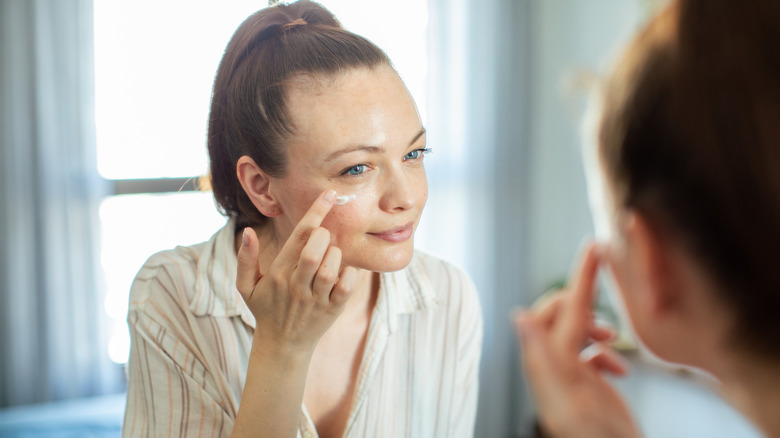
If you have really oily skin, you might be tempted to skip moisturizing, especially if you get sweaty in hotter temperatures. However, doing this is a surefire way to develop poor skin texture and an unhealthy complexion. During our exclusive interview with Dr. Brendan Camp, he explained that this is one common mistake he sees in women in their 40s. "I sometimes hear patients tell me they have oily skin and therefore don't use a moisturizer," he says. "It is still a good idea to use a moisturizer even if you have oily skin."
He explains that cleansing removes dirt, dead skin cells, debris, and excess oils, but can also strip away moisture, which affects your skin's barrier function. "Moisturizing afterwards helps restore the barrier function of the skin and seal in moisture."
However, if you use the wrong moisturizer for oily skin, you'll get even more oily and your pores can get clogged, which will also affect your skin's complexion, albeit in a different way. The solution is to stick to certain types of moisturizers because they are built for oily skin. For example, if you're trying to determine if a gel or cream moisturizer is right for you, you'll notice that most gel formulas are water-based, making them the better option. Generally, you want products that are reliably labeled as oil-free, water-based, non-comedogenic, and even have ingredients like niacinamide, which help control the skin's oil production.
Ignoring your eyes, neck, chest, and hands can make you look older in your 40s
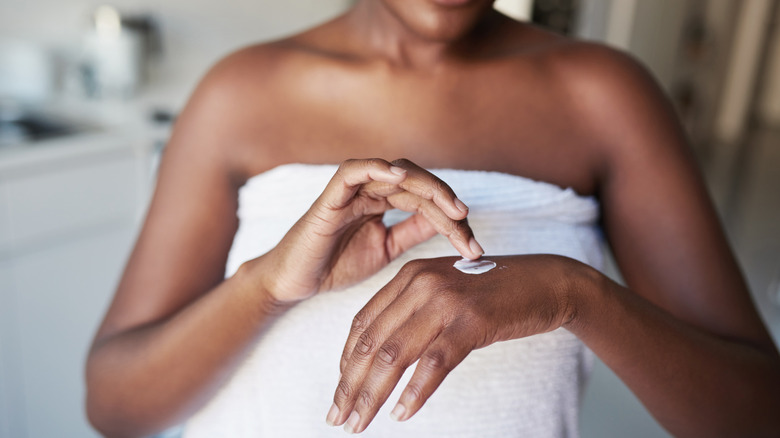
Many women in their 40s take good care of their faces, but don't apply the same level of care to their necks, chests, and hands, which can also suffer from complexion issues. During our exclusive interview, Dr. Brendan Camp explained why this is a mistake. "Skincare products overly emphasize the face, but if unattended to, the eyes, neck and hands can age unharmoniously," he says. Having a face with a healthy complexion can harshly juxtapose poorly aging eyes, neck, chest, and hands, and make them look even worse by comparison.
To prevent this, Dr. Camp advises taking them into consideration when building your routine. "Consider using anti-aging eye and neck serums and creams. Also think about protecting the neck with sunscreen, collared shirts or neck gaiters," he says. "Some hand creams are formulated with anti-aging ingredients to not only moisturize but also reduce premature aging." Youthfull Hands from Revision Skincare, for example, is Dr. Camp's top recommendation to address dryness, premature aging, or uneven tone in hands. For your neck, you typically don't need any extra products beyond what you use on your face, but if it is showing premature signs of aging, Dr. Camp recommends Nectifirm from Revision Skincare.
Don't ignore these ingredients if you're in your 40s

The secret to building a skincare routine that actually addresses your concerns isn't following the hype or spending a ton. Rather, it's knowing what ingredients can get you where you want to be and how to use them. Unfortunately, many women in their 40s don't know what specific ingredients to use to address complexion issues. One of the most important ingredients in this category is vitamin C. It's great for addressing wrinkles and uneven skin tone, and even helps lighten dark spots. The catch? You need to know how to make sure you're picking the right vitamin C serum by ensuring it's made from L-ascorbic acid, which is the active and most researched form of vitamin C.
Another really useful and popular ingredient to use is niacinamide, which improves the general appearance of your skin and helps rebuild skin cells, improve skin elasticity, and support the skin barrier. Finally, ceramides and hyaluronic acid are two more ingredients you absolutely need. They support barrier function, improve hydration, and make the skin appear more radiant.
As you navigate your changing skin in your 40s, these benefits will always be worth elevating your skincare regimen for. More expensive products aren't necessary, but those carefully chosen for their key ingredients will make all the difference.