

Forgotten Style Tricks That Helped '50s Women Craft Hourglass Silhouettes
We may receive a commission on purchases made from links.
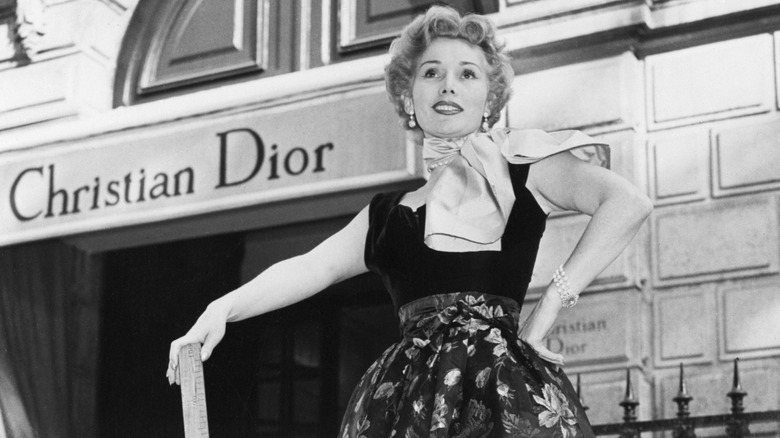
When we think of 1950s fashion, one element stands above the rest: the hourglass silhouette. Marked by a cinched waist and a wider bust and hips, this shape dominated style trends from 1947, when Christian Dior himself released his New Look Corelle Line. Two years out from the end of World War II, the legendary designer's vision shifted fashion away from the slim hips and broad shoulders of 1940s trends to the hourglass shape that's still in style today. While many other areas of fashion have changed, we can still learn from the way that women of the '50s accentuated this small-waisted silhouette, and it all began with their undergarments.
"The largest part of the bust should equal the largest part of the hips and the waist should be 10 inches smaller than either," history writer Matt Brown chronicled in his book "The 1950s Look: Recreating the Fashion of the Fifties" (via Glamour Daze). "That means that with a 36 inch bust, ideally the largest part of your buttocks should measure 36 inches and your waist should be 26 inches." To achieve these proportions, women turned to the underwear that their Victorian ancestors had experimented with, particularly in the way of girdles and corsets.
Thankfully for women in the 1950s, boned corsets weren't as popular in the era as they were in the previous century, with elastane and nylon girdles being the preferred option. These would slip seamlessly under their clothes, tightening their waists to create the desired effect. Additionally, bullet bras were also worn to emphasize the bust, which is one way to incorporate Marilyn Monroe's iconic style into your 2026 'fits. Undergarments like these provided the perfect foundation from which to create an hourglass shape, but women also relied on strategic clothing choices to complete the puzzle.
Emphasizing the waistline created the hourglass figure
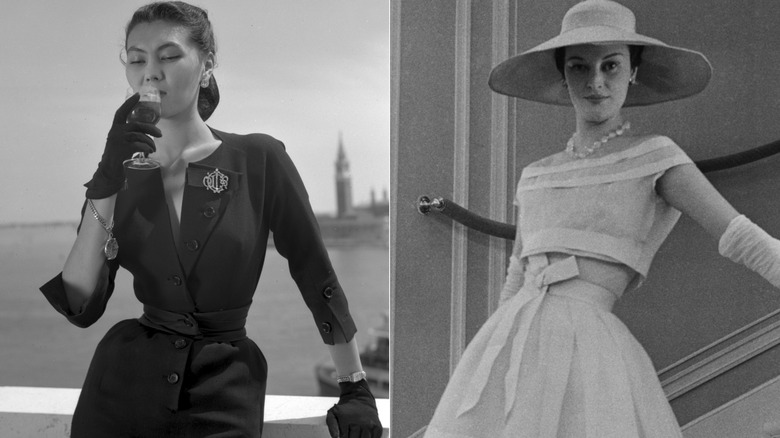
Underwear was crucial in building an hourglass figure, which has been considered an ideal body type at various points throughout history, but it was also just half the story. As Christian Dior demonstrated, clothes played a huge part in nailing the trend. In addition to tie-up and button-up belts that nipped in the waist, this shape was created by amplifying proportions above and below, most notably with voluminous skirts. Wide circle skirts that flounced outwards from the waist are synonymous with the era, and they helped to minimize the center. Sometimes, skirts would be fitted with tulle or crinolines that poof out, boosting the effect.
Because hourglass silhouettes were initially created with underwear, women would also opt for body-hugging fits to accentuate these molded proportions, usually in the way of tight pencil skirts (which re-entered the conversation back in 2023). In terms of the top half of the outfit, slim-fitting bodices would effectively highlight an hourglass figure. Padded shoulders were a thing of the past by that point, though sometimes women would wear boxy jackets which were cinched with belts.
Dior kicked off the trend, but plenty of designers followed suit, including Balmain, Hardie Amies, Balenciaga, and Jacques Fath. Women who shopped from high-end brands had plenty of options, and the only guideline was that the garments minimized the waist, either by cinching it in or emphasizing the areas above and below. As the 1952 Vogue Paris Collection report detailed of the runways at the time, "It begins at the waistline. The waist is what catches the eye right away. It's newly high, it's newly low, or it's both ... but it's always there, always stressed, and because that's the case, fashion looks more feminine than it has in years" (via Vogue).