

Only Real Princess Diana Fans Know These Facts About Her Most Iconic Outfits
We may receive a commission on purchases made from links.
In the realm of fashion, the legacy of Princess Diana has ascended to almost godly heights. Her aesthetic is still called upon today as a beacon of '80s style, and the mere memory of her sartorial finesse can still bring critics to their knees. As royalty hopping between galas and banquets on the regular, she wore several iconic looks during her time in the spotlight, and in the years since, these have developed their own lore. Now, myths and legends surround the princess' most famous outfits, from her show-stopping wedding gown to that sheep sweater. But only real fans can wade through the rumors and actually know the truth behind these unforgettable looks.
"She did enjoy the idea of surprising people, and dressing with little twists, or something unconventional — for example wearing mismatching evening gloves, one red and one black, wearing a tuxedo trouser suit, patterned tights," Eleri Lynn of the Royal School of Needlework mused in a 2023 interview with BBC Culture. We can certainly see these "little twists" in some of Diana's clothing choices, from her shoes that contained a secret message, to her red carpet gown that evoked one of her own idols.
Princess Diana's wardrobe definitely changed after leaving the royal family, but she never stopped turning heads with her rotations. In fact, Princess Diana's revenge dress became one of the most iconic looks in fashion history. We could write a whole book about her most emblematic pieces (and many have already been written on this very subject), but today we're focusing on the few 'fits that have unexpected truths behind them. All these years later, it looks like the late princess is still surprising people through her fashion.
Princess Diana's honeymoon outfit could have looked very different
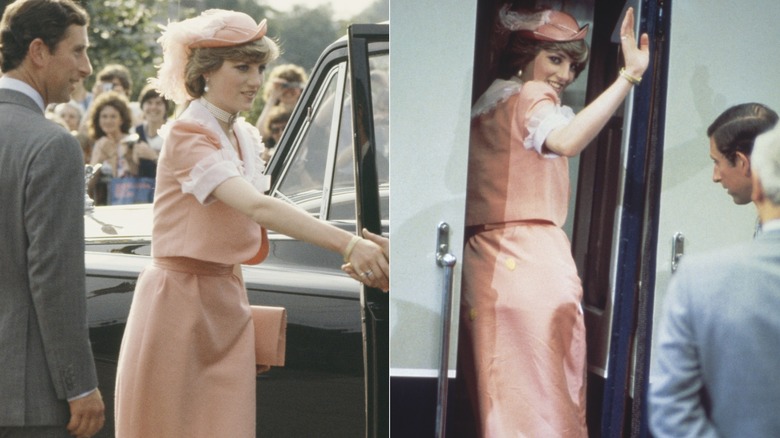
Before Princess Diana married into the royal family in 1981, the aristocrat had much more anonymity. While the quieter life had its benefits for Diana, it also meant she missed out on the superstar treatment that she later received, as was the case when she wandered into Bellville Sassoon seeking a honeymoon outfit to follow her fairytale wedding.
The peach '80s-coded ensemble might not be quite as famous as the bridal gown that preceded it, but the striking set was immortalized in snaps taken of the newly married couple as they boarded the royal yacht Britannia for their honeymoon. But the look could have been totally different, since the London-based designer actually turned the princess away when she stumbled into their store. Although she was engaged to the future king, the shop assistant had no idea who Diana was, and instead suggested that she go to look for an outfit in Harrods. The ever-polite princess-to-be returned with her mother, a longtime client. Once the designers understood who she was, they accepted the commission to make her honeymoon outfit, kicking off a long relationship that defined Diana's style story over the years.
After initially getting off on the wrong foot, Bellville Sassoon was responsible for several of Diana's most prominent looks, including the whimsical pink-and-purple belted gown she wore to an exhibit at the Victoria and Albert Museum in 1981. That dress became iconic in its own right, since the exhausted princess was photographed falling asleep in it while at the event, prompting Buckingham Palace to announce her first pregnancy with Prince William. In hindsight, many of Diana's most unforgettable 'fits would look completely different if her mother had never taken her back to Bellville Sassoon.
Princess Diana's Cannes gown was inspired by another princess
There was an undeniable connection between Princess Diana and Princess Grace of Monaco. Both women married into royalty, becoming princesses on the global stage and navigating the extreme highs and lows of that lifestyle. Both tragically had their lives cut short in car accidents, and both have left behind enduring legacies. The two princess are each style icons in their own right, and it seems the younger Diana was herself inspired by Grace.
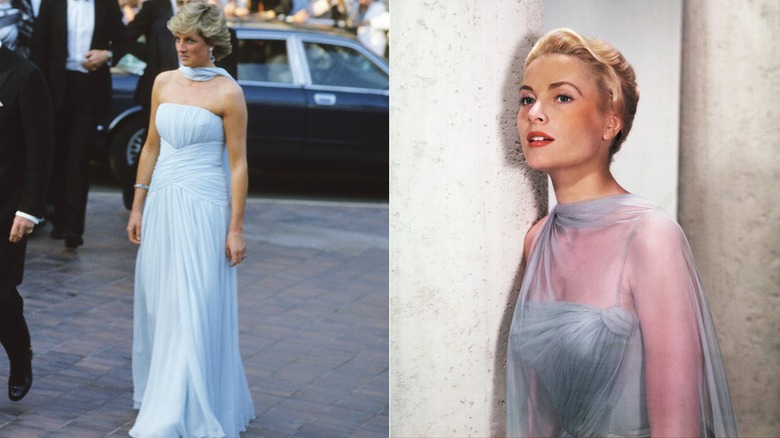
At the Cannes Film Festival in 1987, Diana looked celestial in a blue Catherine Walker silk chiffon gown paired with a matching chiffon stole. As it turns out, Diana had modeled her look on a similar Edith Head dress that Grace had worn in the 1955 flick "To Catch a Thief." The resemblance between the two gowns was impossible to ignore, from the strapless silhouette to the ethereal stole. Diana may have specifically chosen this film festival to honor to her role model, since Cannes was where Grace and Prince Rainier first met, changing the course of her life.
Diana's fondness of Grace, who died in 1982, was clear not just through her fashion at Cannes, but also in her relationship with the former movie star during her life. Reportedly, Diana broke down in tears in front of the elder princess ahead of her wedding, asking for guidance from the one person who was best-placed to give it. She was also understandably heartbroken by the loss of her friend, appearing shaken at her funeral. Diana obviously loved the dress that was inspired by the late princess, also wearing it to the 1989 premiere of "Miss Saigon." In 1997, the gown was sold at auction for $70,700, and later fetched $132,000 when it was sold again in 2013.
The John Travolta dress wasn't actually black
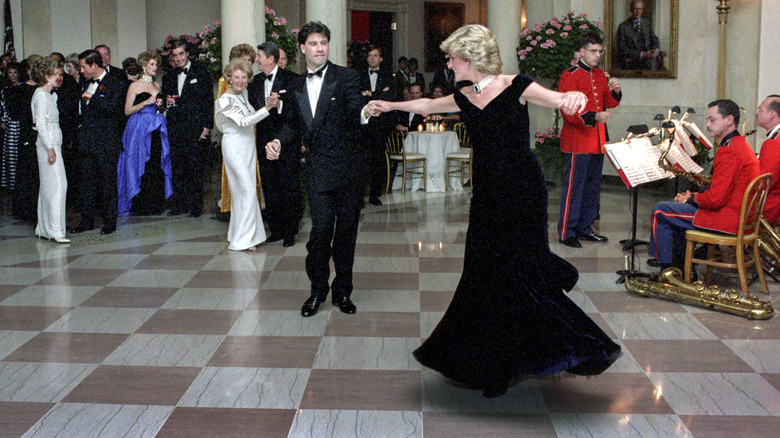
Princess Diana had a fair few iconic dresses in her closet, and one of the most unforgettable is what has since been dubbed "the Travolta dress." In 1985, while attending a dinner at the White House, the Princess of Wales shared a dance with John Travolta. Photographers captured the history-making moment where a movie star twirled a princess 'round the dance floor, and her off-the-shoulder velvet Victor Edelstein gown became the stuff of legend. Except, most people read the dress as being black, to match Travolta's tux. In actual fact? The fairytale frock was midnight blue.
"Actually, it's always been described as black because it's a very dark blue that only appears blue at certain angles of light, but in most cases it looks completely black," one Redditor explained of the confusion. It actually could have been another shade entirely, as Diana first saw the dress in burgundy at Edelstein's atelier. But when she asked for it to be made for her, she requested blue. As Prince Harry noted while reminiscing on footage of his christening day in 1984, "Mummy looks great in blue" (via TikTok).
The princess wore the Edelstein "Travolta" dress around eight times in total, and was reportedly so captivated by it when she first tried it on at Kensington Palace that she called then-Prince Charles in to see it on her. "It stands the test of time and doesn't date like some of her other early '80s looks," Royal Ceremonial Dress collection curator Eleri Lynn revealed of the gown (via InStyle). "The dress marks a turning point in her fashion story, where the incredible New Romantic frills and ruffles gave way to a timeless, classic silhouette ... You could wear it today and still be the best dressed person."
There was a secret message on Princess Diana's wedding shoes
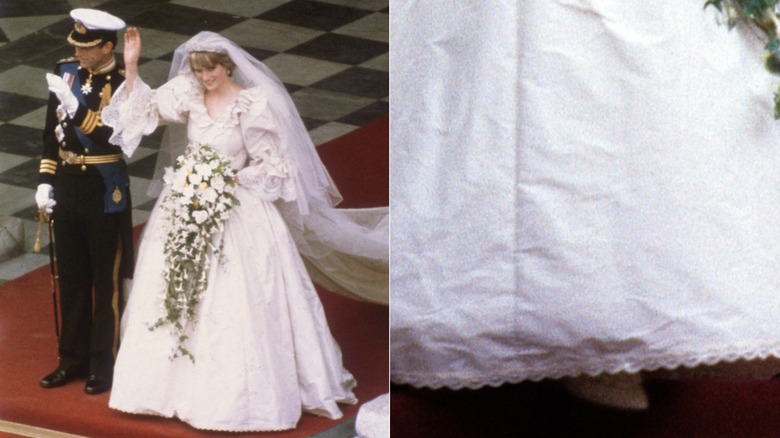
Few wedding days will reach the levels of fanfare that then-Prince Charles and Princess Diana's did in 1981. While Diana's David and Elizabeth Emanuel dress has opinions divided to this day, with its overwhelming taffeta, ruffles and puffs, and cathedral-length train, her scarcely seen wedding shoes have all but flown under the radar. Only true fans of the late princess know what the shoes looked like, let alone that they contained a secret message.
Designed by Clive Shilton and Julie Smith, the shoes were made of Nottingham lace and featured 542 sequins and 132 pearls. According to the book "Worn on This Day: The Clothes That Made History," they took six months to make, requiring the help of every staff member. And within the hearts fashioned by the embroidery, the shoes each had a letter printed on them in gold leaf: C and D. Given the volume of the dress, the shoes weren't designed to actually be seen, but were rather intended to carry the initials of the newlyweds in secret, as a romantic gesture for their hearts only.
"Her main concern was that she wouldn't appear taller than Prince Charles, and because she was very tall — 5'10" — the shoes would have to have a low heel," Shilton recalled in an interview with the Daily Mail (via InStyle). Two pairs of the fairytale shoes were created, in case one was wrecked before the big day, with the first pair being passed on to Diana's family after her death, and the second pair being sold at auction for the equivalent of $75,000.
Princess Diana actually had two iconic sheep sweaters
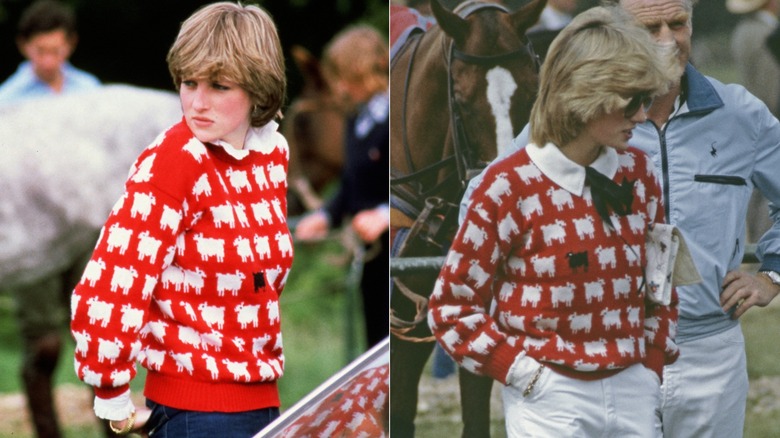
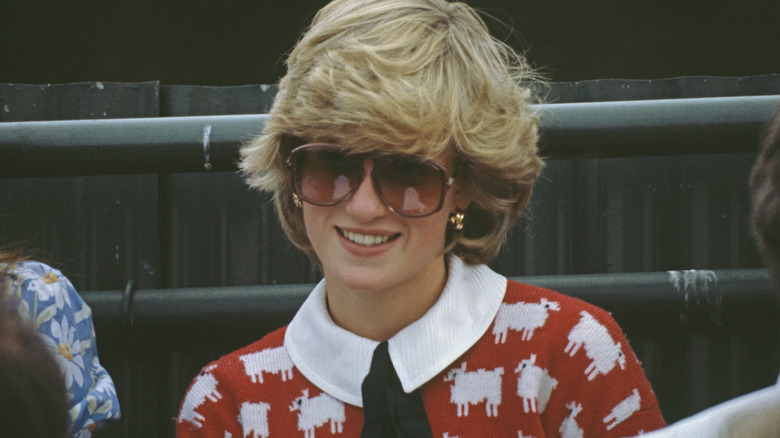
If there was one piece from Princess Diana's wardrobe that had a hope of causing as much of a stir as her decade-defining bridal gown, it was the sheep sweater. Created by the brand Warm & Wonderful, the sweater that she wore in June 1981 to a polo match ahead of her wedding has gone down in history. The design, showing a group of white sheep and a single black sheep amongst them, has instigated several fan theories, with the general consensus being that the late princess wore the sweater to convey that she felt like an outsider within the royal family. While that hypothesis has since been challenged by experts, the real surprising fact behind this garment is that there wasn't just one sweater, but two of them.
After Diana wore the sweater in 1981, she accidentally damaged it, but by then she loved it so much that she asked the designers to make her another one. She wore the second one in 1983, again to a polo match. While she initially paired the first one with blue denim, she dressed up the second version with white pants, a Peter Pan collar, and a black ribbon bow.
And according to Eleri Lynn, this statement-making collar might not have been trying to make a statement after all. "I don't believe at that time she would have had a sense of the 'one black sheep' idea, or that she even had a sense of the impact of the fashion she wore," she told BBC Culture in 2023. Princess Diana certainly used her street style to send a message to the royal family, but that was in her post-princess era, when she was aware of her own sartorial power.