

What Exactly Is 'Ozempic Neck'? We Asked A Doctor

We've all heard of the dreaded "Ozempic face" — evident on celebrities like Oprah Winfrey and Christina Aguilera — but a lesser-known side effect often caused by GLP-1 medication is an "Ozempic neck." In order to understand what it means, how it happens, and whether it can be prevented or treated, we've enlisted the help of Dr. Jason Singh, the chief medical officer of One Oak Medical Group. Exclusively for Glam, the physician explained what anyone starting their GLP-1 journey should be aware of.
"As a primary care doctor that prescribes GLP-1, I have noted 'Ozempic neck,' which is loose, crepey, sagging skin along the jawline and neck because of rapid, significant weight loss," Dr. Singh said. "What's happening is that the volume is lost faster than the skin's intrinsic remodeling capacity can compensate." This, in turn, results in a neck that often looks older than it should.
"It's worse for the aging population," Dr. Singh added. "Other risk factors besides chronological age above 40 (when collagen turnover is already attenuated) include a history of significant prior weight fluctuations that have already prestressed dermal fibers, chronic sun exposure, and smoking." Those who fall into any of the risk groups should be cautious of the speed of their weight loss and address concerns regarding their neck with a health care professional.
Can 'Ozempic neck' be prevented?

Even though most people on a GLP-1 medication are thrilled to see their weight go down, the truth is that rapid weight loss isn't good for the appearance of their necks (or faces, for that matter). "The speed of weight loss matters enormously," Dr. Jason Singh explained exclusively to Glam. "I prefer my patients to lose no more than 2.2 pounds per week to give the skin enough time to adjust." Losing weight at a more natural pace allows your skin to keep up with the necessary adjustments, and it prevents the appearance of saggy areas.
"I counsel my patients that the goal should be to lose weight thoughtfully, with attention to adequate protein intake (which provides the amino acid substrate for collagen synthesis), resistance training to preserve lean mass, and ideally a pace that gives the skin the best possible chance to adapt," Dr. Singh adds. In fact, back in 2023, we already discussed why you may want to try resistance training for more supple skin – and now it's doctor-approved.
Taking care of your skin while losing weight is also crucial to help prevent the appearance of a saggy neck. Sunscreen should be a part of your daily neck skincare routine, and while there is specialized neck skincare, using face products is completely fine. Since hydration is key when it comes to skin plumpness and overall health, ensuring your daily water intake is around 9 cups or 72 ounces is always a good idea.
How to treat 'Ozempic neck'
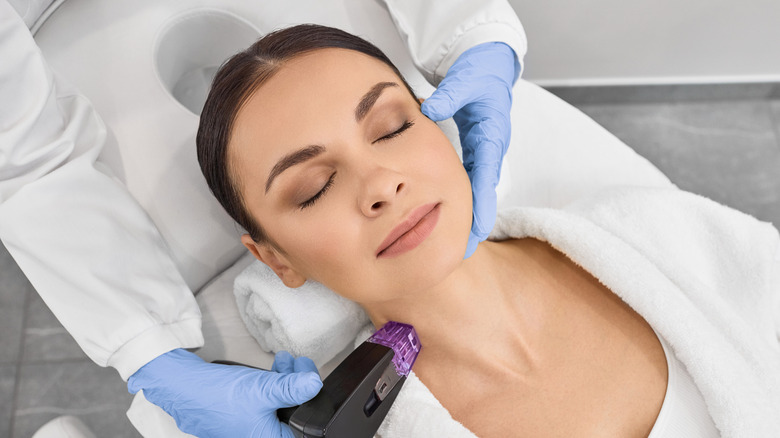
While it is always better to prevent rather than to treat, the truth is that "Ozempic neck" is a problem that can be fixed. With GLP-1 medication, initial rapid weight loss is common in the first two months of use, and often, the patient taking it isn't even thinking about skin sagging before they notice it. While "Ozempic neck" doesn't necessarily happen to everyone, there are ways to tighten the skin on your neck again if it happens to you.
"Once this laxity develops, options range from non-invasive procedures like radiofrequency microneedling and high-intensity focused ultrasound, injectables like biostimulators (Sculptra, Radiesse), to surgical intervention," Dr. Jason Singh told Glam exclusively. "I do let patients know they should not let fear of cosmetic changes deter them from the profound metabolic, cardiovascular, and longevity benefits of meaningful weight loss."
In 2023, we discussed the rise of NeckTite, a non-invasive cosmetic procedure aimed at sculpting skin, which is a great option for anyone struggling with "Ozempic neck." Other common treatments done to help with the sagging skin on the neck include laser resurfacing and fat transfer. Depending on how much loose skin there is in the area, a combination of multiple different treatments may be best. But as always, it's best to consult a dermatologist or surgeon before committing to a procedure, even if it is non-invasive.