

Queen Elizabeth's Style Evolution, In Photos
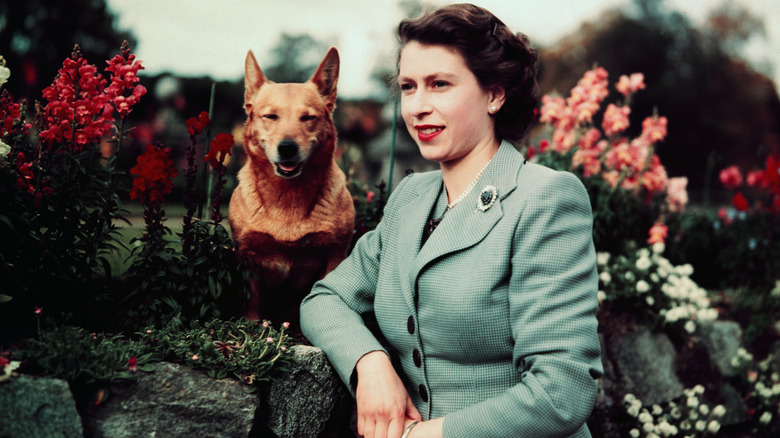
The longest-reigning monarch in the history of the U.K., Queen Elizabeth II is remembered as one of the most influential figures of the 20th century. From being the first British monarch to address the U.S. Congress, to making the line of succession to the British throne gender-neutral, the late queen achieved much during her 70-year reign. And from the very beginning — even in the years before she ascended to the throne — to the end, she demonstrated a unique fashion prowess that only a monarch could pull off.
Along with considering her personal tastes and the trends of the era, Elizabeth also had to take into account how each 'fit would land on the world stage. "We would look at the garments in daylight and in electric light," designer Stewart Parvin recalled of designing clothes for the queen (via The Telegraph). "It's really important how they photograph in different lights." Queen Elizabeth wore monochrome outfits so often, mostly in bright shades, because she needed to be easy to spot in a crowd. "You also have to make clothes in which the Queen could get out of a carriage or get out of a car without any mishaps," Parvin added. "When the Queen arrives, she's instantly on show. The clothes have to flow in a way that they look perfect all the time." All this is in addition to the symbolism and politics that went into Elizabeth's rotations, from wearing tweed in Scotland to all-black in mourning, so her wardrobe could be seriously complicated.
But through the years, Elizabeth curated a definitive style that was distinctly hers. Blending her country-coded roots with the glamour of high society, her fashion was both classic and contemporary, statement-making and appropriate, all at once.
1940s: Princess Elizabeth twins with sister Princess Margaret
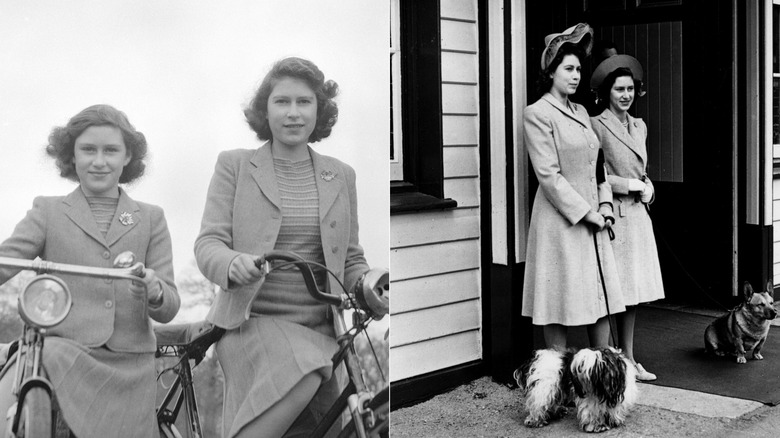
In the 1940s, Queen Elizabeth II was still Princess Elizabeth, the first daughter of King George VI. With war ravaging Europe, she spent the first half of the decade at Windsor Castle with her sister Princess Margaret, and the two young royals were often dressed similarly, if not exactly the same. In 1942, they posed for a portrait at Windsor wearing identical pleated skirts with matching striped blouses and wool blazers. Then in 1946, the princesses were photographed near Balmoral Castle in Scotland, both dressed in knee-length coat dresses, gloves, and hats. With the war behind them, the two royals returned to their usual sophisticated garb.
1947: Queen Elizabeth's wedding dress was her most iconic fashion moment
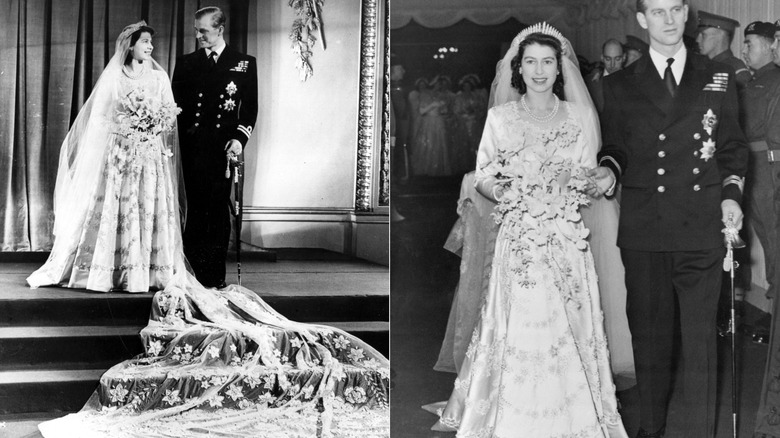
In November 1947, Queen Elizabeth II, then still Princess Elizabeth, tied the knot with Prince Philip at Westminster Abbey. Though she wasn't yet the reigning monarch, this was a pivotal moment in her fashion journey, transitioning Elizabeth from wartime staples to the glamorous wardrobe she would eventually exhibit — though her Norman Hartnell dress was paid for with clothing coupons. Featuring stars and florals, the gown was inspired by legendary artist Sandro Botticelli's "Primavera." In our view, this remains one of the most unique wedding dresses in modern royal family history.
1950s: Queen Elizabeth embraces the decade's fashion with a royal twist
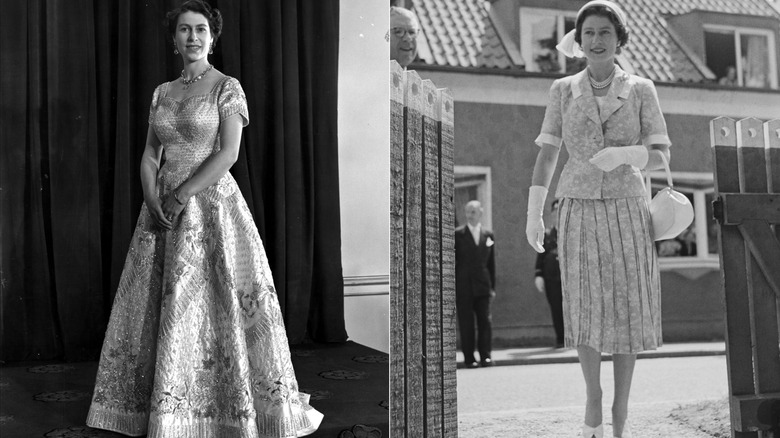
In 1953, Princess Elizabeth was coronated at the queen of England, wearing another Norman Hartnell number for the occasion. With detailed embroidery on the flouncy skirt and a fitted bodice, the ballgown-style dress was a mainstay of the decade. Fast-forward to 1956, and Queen Elizabeth was snapped while on a museum visit in Stockholm, Sweden. She rocked more staples of the decade, including a pleated skirt and pillbox hat with a romantic bow. The multi-stringed pearls might have been a hallmark of the 1950s housewife, but the white gloves gave this look a glamorous royal makeover.
1960s: A decade of glamour for Queen Elizabeth
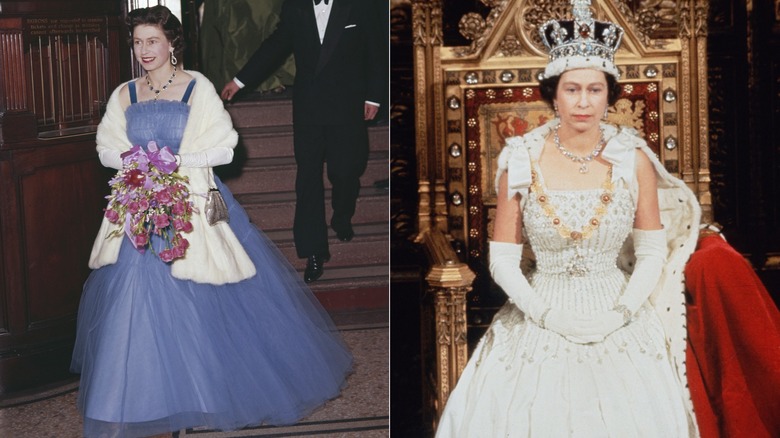
Queen Elizabeth II experienced endless moments of glamour and sparkle during her reign, and the 1960s brought us many of them. In November of 1962, the 36-year-old queen dressed to the nines for an event at the Golders Green Empire theater, opting for a whimsical periwinkle ballgown, elbow-length evening gloves, and a white fur stole. Then in 1966, she attended the State Opening of Parliament, sporting a stunning Norman Hartnell ballgown that her granddaughter Princess Beatrice would go on to adapt and wear as her wedding dress in 2020.
1970s: Queen Elizabeth plays with pops of color
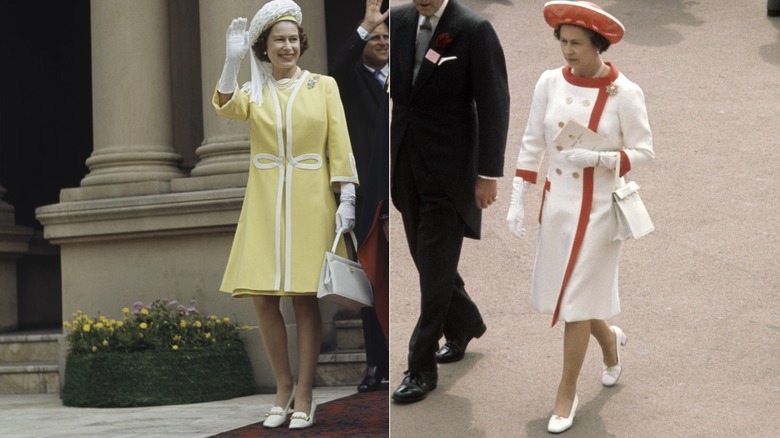
As her reign went on, Queen Elizabeth II came to embrace bold shades in her wardrobe. In the 1970s, this was often in the form of pops of color. For a visit to Sydney, Australia, in May 1970, the monarch went with a butter-yellow coat with white piping that she paired with white gloves, a white statement hat, white court shoes, and her signature white handbag. She seemed to have a similar strategy at the Royal Ascot horse race in 1976, when she chose a sophisticated white coat finished off with red detail and a red-and-white hat.
1980s: Queen Elizabeth finds her monochrome sweet spot
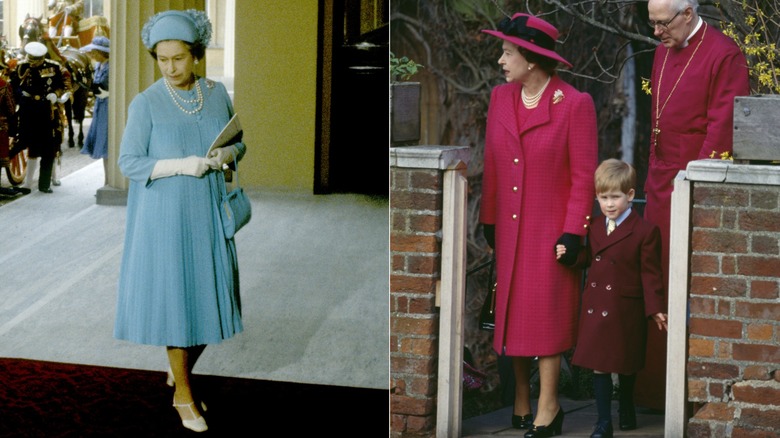
By the 1980s, Queen Elizabeth II had settled firmly into her monochrome sweet spot, which would be one of the most definitive fashion moves of her entire reign. For the monumental wedding of Prince Charles and Lady Diana Spencer, who later became the Prince and Princess of Wales, she went for a smock-style sky-blue dress with a matching hat and bag, though her go-to white gloves, pearls, and shoes finished off the look. Not much had changed by the end of the decade; attending Easter church service at St. George's Chapel in 1989, the queen chose a berry coat and matching dress.
1990s: The Queen explores standout statement looks
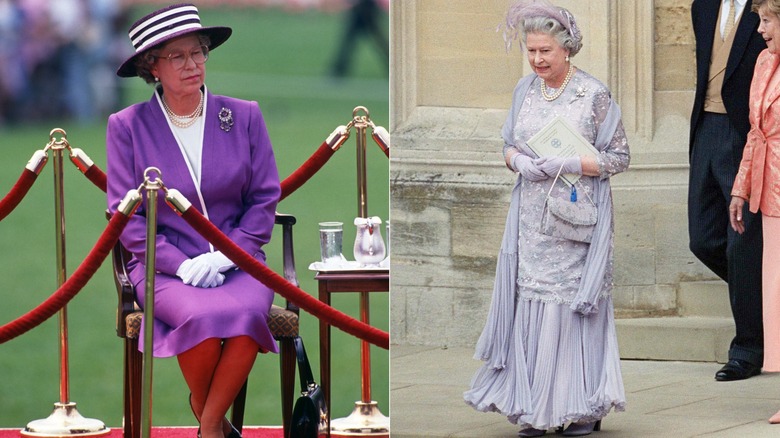
The world was used to seeing Queen Elizabeth II rock her vibrant monochrome 'fits by the 1990s, which might be why she started experimenting more in the last decade of the millennium. For a visit to the White House in 1991, she made a statement with a striped purple-and-white hat that complemented her bright purple skirt suit. Eight years later, she chose purple again for the wedding of Prince Edward and Sophie Rhys-Jones, this time opting for an ornate lavender dress with sheer sleeves. The unique details of these styles made them standouts in her wardrobe of block-color skirt suits and coat dresses.
2000s: Queen Elizabeth can still surprise us
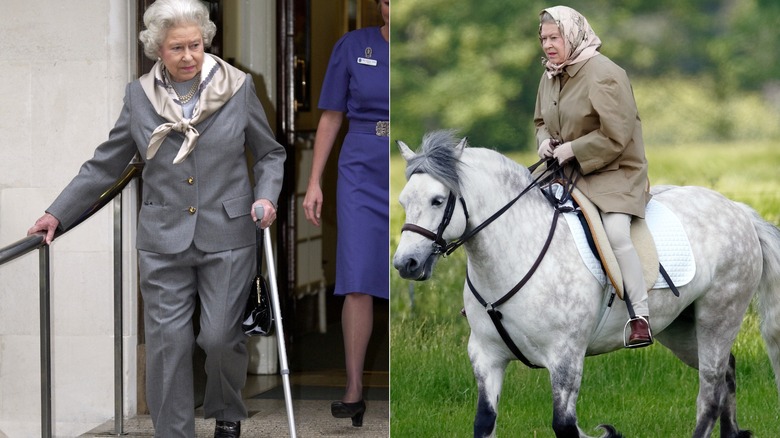
Having spent a lot of time in the country, even undergoing training to be a mechanic as a young woman, Queen Elizabeth II was no stranger to more masculine silhouettes. We might have associated her with skirts and dresses, but she also knew how to rock a chrome pantsuit, as she did in 2003 when she was snapped leaving a London hospital. The monarch kept it ever-so-stylish with impeccable tailoring and a silk scarf, not to mention her beloved pearls. In June 2006, she donned cream jodhpurs and a khaki jacket for a ride around Windsor, looking chic with a scarf head wrap.
2010s: Brighter palettes are the style du jour
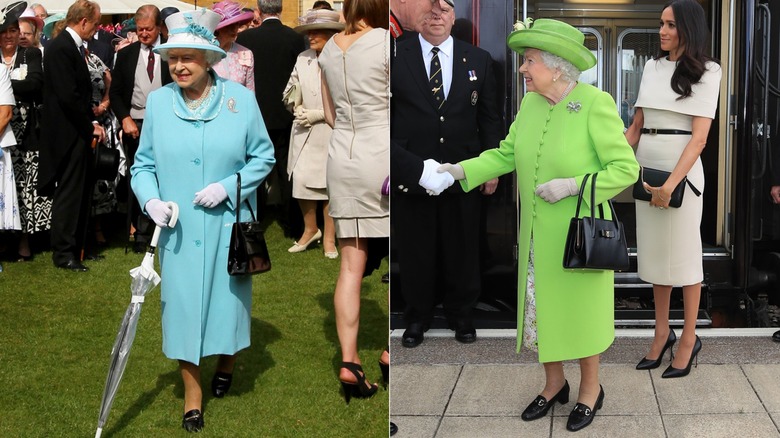
Most people's wardrobes mellow as they age, but Queen Elizabeth II's style just got brighter in her 80s and 90s. For a garden party at Buckingham Palace in 2010, the monarch stuck to her signature in an almost Tiffany-blue coat dress with a tall white-and-blue hat. But we've never seen her monochrome dressing go brighter than it did in June 2018, when she stepped out with Meghan Markle for a royal visit to Cheshire, England, donning a lime-green coat and matching hat. Onlookers definitely didn't have to worry about missing their glimpse of her in that 'fit!
2020-2022: Queen Elizabeth maintained her signature style to the end
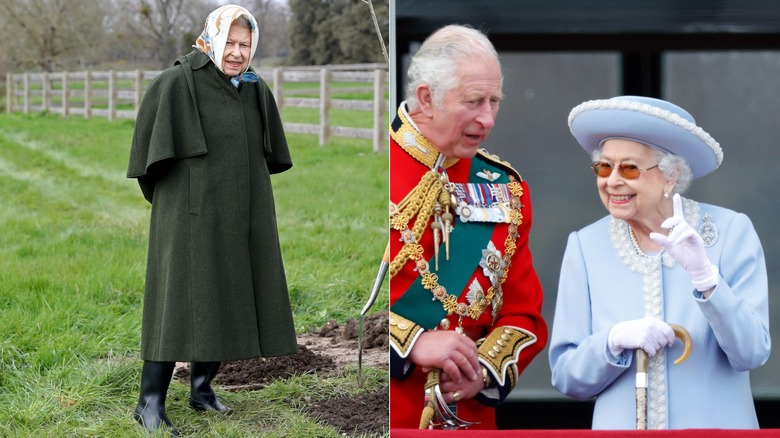
From her colorful coat dresses and matching hats to her equestrian staples and headscarves, Queen Elizabeth II wore her favorite garments proudly. For a May 2021 photo at Windsor, she posed in a hunter-green coat, making the look queenly with a patterned scarf. At Trooping the Colour in 2022, in what would be one of her final public appearances, the queen proved that she could still nail a monochrome ensemble with a pastel coat and matching hat, both embellished with tiny pearls. It was this confidence in what she wore that enabled the late Queen Elizabeth to have an undeniable mark on British fashion.