

Does Menopause Change Your Skin Type? According To Shania Twain (& Science), It Definitely Can

It's no secret that puberty can change skin — acne, oiliness, blackheads, and all our other least favorite things come out to wreak absolute havoc on unsuspecting teens. But it kind of is a secret that menopause, often described as "second puberty" or "puberty in reverse," can also affect your skin drastically. Not enough people are talking about menopause and the changes it can bring to your body, but country superstar Shania Twain sure is, which makes her all the more iconic in our eyes.
The singer, now in her 60s, revealed that, among the less fun changes and symptoms, there actually has been a silver lining to menopause: she doesn't find herself having to deal with a ton of breakouts, and her skin isn't terribly dry anymore (via Hello!). She characterized her current skin type as being closer to combination skin. (If that's you, here's what to look for in a serum if you have combination skin).
So what is actually going on here? Is menopause really the driving factor behind Twain's skin changes? The country singer is right on the money, according to Vanessa Coppola, MS, FNP-BC, and founder of Bare Aesthetic. The integrative aesthetics and menopause expert celebrated the star's willingness to be open about the changes her body is going through. "I love that she said this out loud, because it validates what so many women experience and are told to ignore," Coppola tells Glam exclusively. "Yes, skin type absolutely changes across a lifetime, and menopause is one of the most significant inflection points." She goes on to say that Twain's experience "is not bizarre at all. It's biology, and it's exactly why I tell women that the skincare routine they built at 35 was never designed for the skin they have at 55."
What is it about menopause that causes your skin to change?
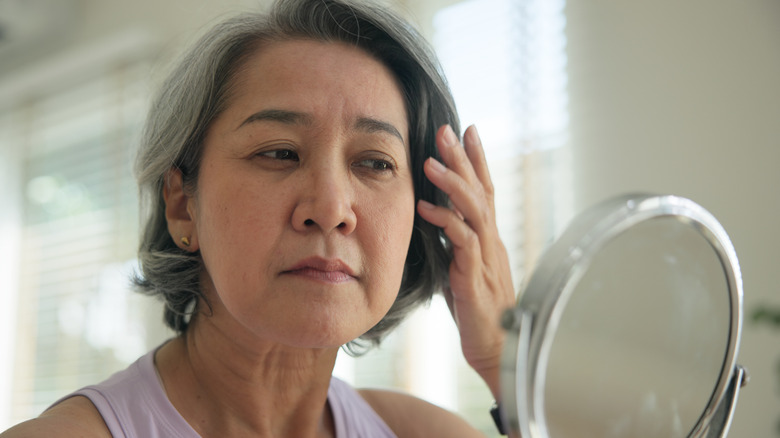
Skin transformation during menopause is, in part, caused by your estrogen level decreasing (per the National Library of Medicine). That means lowered collagen production and less of the elasticity that keeps skin looking fresh and bouncy. Androgens, another essential type of hormones that decrease during menopause, can also contribute to changes, according to Vanessa Coppola.
"What Shania describes, less flaking and breakouts with a newly oily T zone, reflects the shift in the ratio between estrogen and androgens," Coppola explains to Glam exclusively. "Estrogen declines steeply while androgens decline more gradually, so the androgen influence becomes relatively stronger, and androgens drive oil production. For some women that means oiliness or adult acne in areas that were never a problem before, while other areas of the face become drier because of the loss of hydration and barrier function that estrogen supported."
Coppola shares some skin symptoms to watch for throughout menopause, from dullness to slower wound healing. Unlike Shania Twain's experience, some women may notice their skin becoming even drier and duller, or prone to new sensitivities to products they've used for years. "I always tell my patients this: these are not cosmetic complaints to be dismissed," Coppola says. "They are clinically real symptoms of a hormonal transition, and they deserve real answers." Here are some more crucial things to know about changes in your skin during menopause.
How to handle changes in your skin brought on by menopause
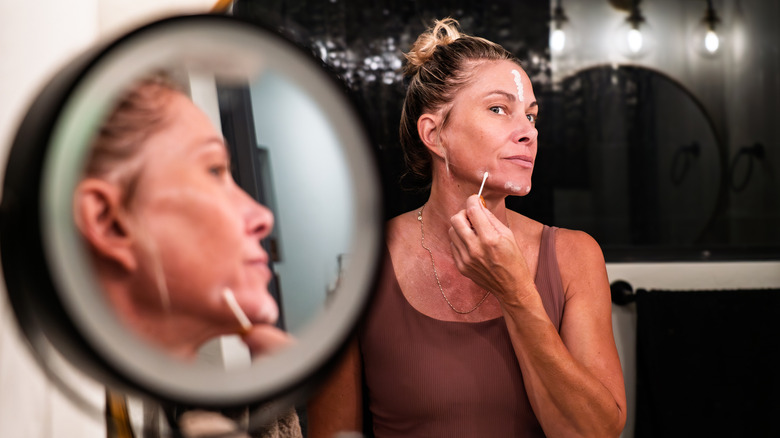
What's to be done when your skin starts going rogue? Vanessa Coppola advises women to not let anyone dismiss their symptoms as "just aging." "You know your skin better than anyone, and if it feels different, it is different," she says.
The menopause-certified clinician recommends a new skincare routine focused on hydration and barrier support, coupled with regular sunscreen use. "Find a menopause trained clinician who understands that skin, hormones, and metabolism are all connected, because a heavier moisturizer alone cannot correct what is fundamentally a hormonal shift," Coppola shares in our exclusive chat. Shania Twain uses olive oil and sugar as a makeup remover, but you might want to ask your dermatologist about that particular combo before adding it to your routine.
Ultimately, taking care of your newly changed skin is about understanding the underlying cause of those changes and finding what works for you. "My practical advice is to treat skin changes as a signal to look at the whole system, not just the surface," Coppola tells us. She also advises women to "ask real questions about whether hormone therapy is right for you, because for many women it is safe, effective, and transformative for skin and so much more."