

The Best Ways To Care For Your Hair If You Have Irish Curls

Irish curls, plopping, diffusing — sometimes, caring for curly hair feels like you need a manual and a dictionary just to get started. Irish curls in particular are even more complex than regular curls because they are a mix of curls or waves and straight hair, with the curlier strands usually underneath. The good news, though, according to celebrity and editorial hairstylist Kazu Katahira, is that Irish curls aren't a rare or new thing, so navigating them isn't a mystery. During an exclusive interview with Glam, he pointed out that what we now call Irish curls have been around long before the term itself.
"Honestly, I think this isn't a new phenomenon, it's just gotten a catchy name recently," he says. "Almost everyone has some texture variation across their head: Hair around the nape and the hairline tends to curl more than hair on top." One reason may be that the hair in those areas is often naturally finer, and finer hair can hold a curl more easily. Similarly, those areas aren't dealing with gravity that makes hairs on top of the head fall into a looser pattern. Another factor is heat or bleach damage, which can disrupt the curl pattern in certain sections of hair.
Regardless, it's not a rare hair type. "That combination is very real and consistent. It shows up on almost every client I put loose waves or curls on," he adds. Understanding how Irish curls come about is one thing, but we're still left with the most important question: How do you care for two different textures on the same head of hair? According to Katahira, the secret to caring for Irish curls lies in working with the difference, not against it.
Work with the pattern of your Irish curls, not against it
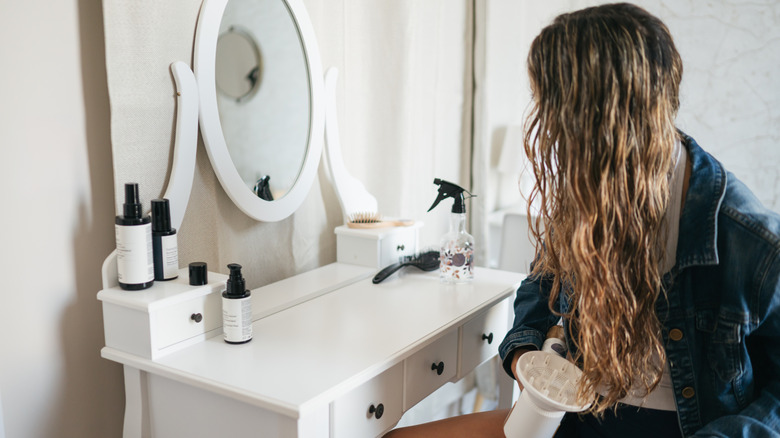
If you've been trying to figure out that one routine that'll work for your Irish curls and have had no success, it's because you don't need one routine — you need two. While you can simplify some steps, like using a shampoo that works for both curly and straight hair, the curly and straight sections of your hair need to be treated differently for the most part. "The curlier lower section needs more moisture and curl-defining product; the straighter crown gets weighed down if you treat it the same way," Kazu Katahira says during our exclusive interview.
To start caring for Irish curls the right way, you need a solid curly hair routine that's focused on maximum hydration. You'll also need to know the basics of curly haircare like air-drying, using hydrating products like a curl cream or some mousse, and finishing up by plopping with a T-shirt or microfiber towel. If you're not familiar with the term, here's everything you need to know about plopping curly hair.
Similarly, when it comes to styling Irish curls, you'll need to work with your hair pattern and not against it. Since the curlier part of your hair is likely to hold a curl on its own, focus your efforts on getting the straight section to match. As Katahira explains, "I focus my curling iron work on the crown/top section specifically, to bring it up to match rather than re-curling hair that's already doing its job."
The right haircut can make your Irish curls look cohesive
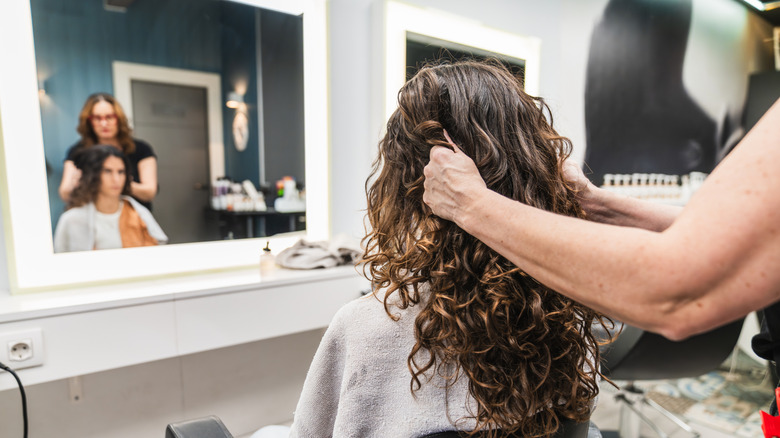
One underrated Irish curls care tip hairstylist Kazu Katahira shared during our exclusive interview is getting the right haircut, especially if your hair is on the shorter side. "This is where a good stylist matters most," he says. "Depending on the person, cutting the top slightly shorter, or the bottom slightly shorter, is often what makes the two textures read as one cohesive style instead of two different heads of hair."
Another tip to keep in mind is that soft layered cuts are one of the best ways to get a unified look for your Irish curls. For heavier hair, go for softer layers so the sections don't look disconnected or chunky. You'll also need to take special care when maintaining your cuts. When adding leave-in conditioner to the straighter parts, skip the roots and only apply product from the middle to the end so your hair isn't weighed down.
Additionally, using a diffuser to refresh your Irish curls is a game changer. Diffusing is great for wash-day, but it's also a super useful tool for curl refreshing — just be sure to dampen your hair with a leave-in conditioner or mist first. Secondly, a good technique can help you diffuse your hair with maximum results. "If you're blow-drying, flipping your head upside down while diffusing helps counteract the very gravity pull that straightens the crown in the first place — a small trick that makes a real difference on this specific texture pattern," Katahira adds.
You need the right products to care for Irish curls properly

If you've found your Irish curls incredibly difficult to deal with, you just might be using the wrong products. During our exclusive interview with hairstylist Kazu Katahira, he walked us through products he uses on clients with this hair variation. His first product recommendation was the Oribe Foundation Mist. "I use this all over as a prep step, on both sections. It cuts frizz and helps define curl before anything else goes on." However, he notes that he skips it with thinner hair textures or uses just a bit on the top so it doesn't weigh the straighter sections down.
Next up, he recommends using your regular leave-in conditioner or a curl-defining cream followed by Oribe's Eternal Curls Polish & Protect Oil for your curly sections. "This tames volume, adds shine, and keeps the curl pattern controlled rather than frizzy," he says. If you don't have a go-to product yet, choose one of the best curl creams for every hair type. And for the straighter parts of your Irish curls, he suggests scrunching up a bit of Wella EIMI Extra Volume Mousse. "It sounds strong on paper, but used sparingly it gives just enough hold and texture to help the top curl pattern show up and match the bottom half."
Finally, he recommends air-drying over diffusing when you have the time. But most importantly, realize that your Irish curls don't need to be fixed: "This isn't a flaw or something to 'fix.' It's just normal texture variation ... The right products and a haircut that accounts for it can make the two textures work together instead of looking like a mismatch."