

Old-School Jewelry Trends From The 1920s That Are Making A Comeback
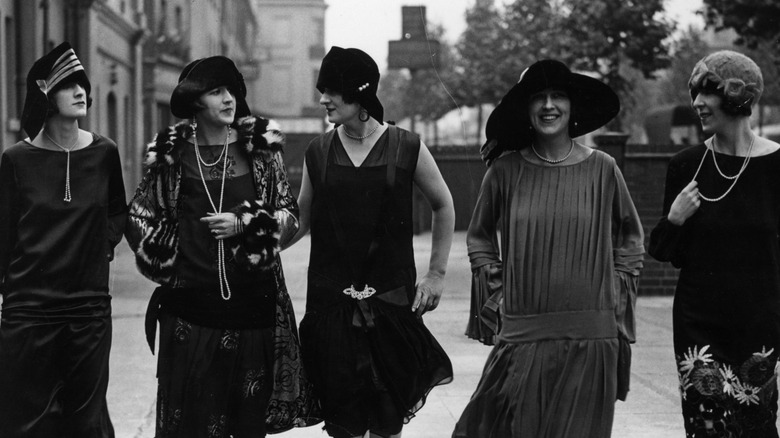
When it comes to fashion, the second half of the 2020s is shaping up to be quite different from the first half. With jewelry as well as clothing, we're moving away from the muted, dainty, and minimal pieces that have marked the last few years, and instead, embracing a style that takes up a little more space with statement-making drama. So, there's no better time to look back to the roaring '20s for inspiration. The decade of jazz, flappers, and unapologetic glamour may be 100 years behind us, but its influence is creeping into the most popular jewelry trends today.
Calling the 1920s "one of the great eras of jewellery," François Curiel, chairman of Christie's Europe and Asia, said in an interview with Europa Star in 2022 that, "The great houses of Place Vendôme — Boucheron, Cartier, Chaumet, Van Cleef & Arpels — were extremely active in this period. Everyone wanted to create the best." In practice, this led to detailed pieces designed to be noticed, which is an approach returning to the jewelry scene today with the resurgence of long sautoir necklaces and modern, eye-catching cocktail rings. Multi-colored jewelry has also been a force in 2026, both among fans of high fashion and those who don't quite have a Van Cleef & Arpels budget.
The wider art deco movement, which brought an artistic flavor to fashion and accessories, was one of the biggest influencers of 1920s jewelry trends. As Pierre Rainero of Cartier explained to the Europa Star, "the influence of geometry" left its mark on everything from rings to earrings, and that unexpected design element is also leading trends today.
Pearls dominated the 1920s and we still love them today
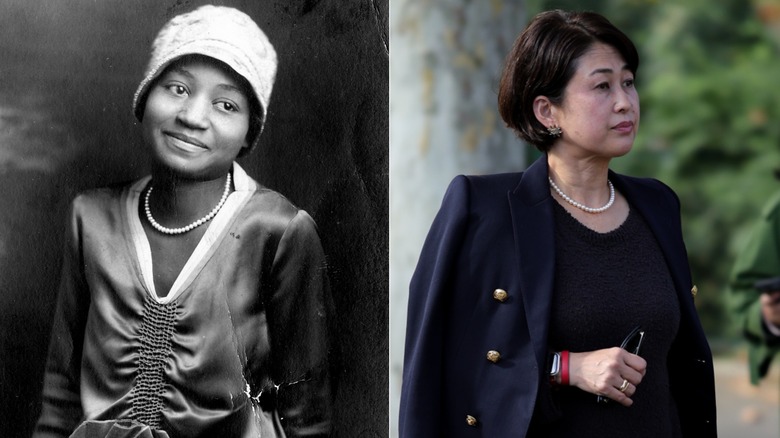
Fashion in the 1920s would have been lost without pearls. Whether real or fake, these classic jewels defined trends in the roaring '20s and were an integral part of the flapper aesthetic. Coco Chanel ushered them to popularity (and made it clear that wearing faux pearls is more than fine), often layering her signature necklaces and bracelets to create her famous aesthetic.
The masses followed suit, and pearls showed up everywhere from timeless collar necklaces to earrings and bracelets. Long pearl necklaces could sometimes reach up to 60 inches before they were wrapped, and they could also be styled with knots. The classic jewelry style is back en vogue in the 2020s, though we're wearing it a little differently, proving that there are endless modern ways to pull trendy pearls into your wardrobe.
In the 1920s, prior to the hard years of the Great Depression and Second World War, pearls were a symbol of glamour, opulence, and luxury. While they still work as a preppy staple to emulate that old-money feeling, the trendier iteration is giving pearls a punk-inspired makeover, similar to the way Madonna wore them in the '80s — interspersed with gothic crosses and chokers. Real pearls are inherently lavish, and fittingly the star of several high-end collections in 2026, but they're less grandma-chic now, and more subversive and boundary-pushing. From giant necklaces to sculptural rings, there's a jewelry design out there for every pearl lover. However, if you want to keep your look low-key, there are simpler styles that will accentuate your outfits without coming across as too bold.
1920s fashion paired perfectly with drop earrings of all styles
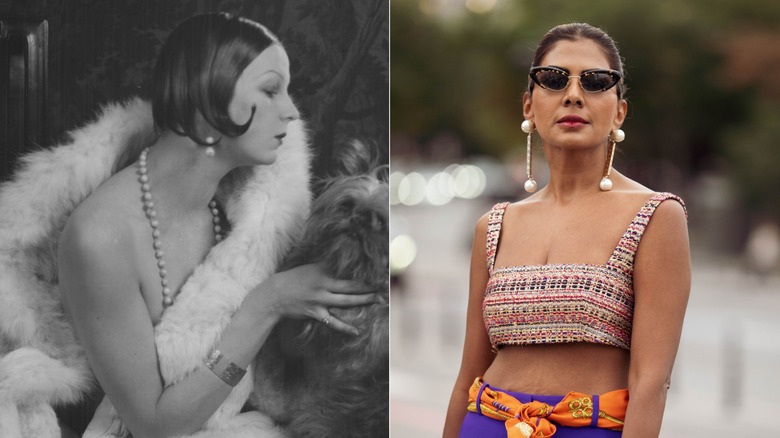
Whether with pearls, diamonds, or colorful gemstones, drop earrings were one of the most sought-after jewelry styles in the 1920s, bringing a touch of drama to more understated and practical wardrobes (although extravagant flappers wore them, too!). Perhaps dangly earring styles did so well in the 1920s because they married perfectly with beauty and accessory trends like shorter hairstyles and cloche hats. Even for women with long hair, more formal events often called for elaborate hairdos that were pulled to the side, offering the perfect opportunity to don just one statement drop earring.
In the 1920s, this style came in an array of designs, with filigree metalwork being one of the most popular. Along with colorless gems like diamonds and rhinestones, drop earrings might also feature a rainbow of shades in the form of stones like coral, agate, carnelian, turquoise, and jade. Women of the age would often match their earrings to their headbands, brooches, and hair clips for a cohesive look.
In some form, drop earrings have always been in demand. But a century later, we're seeing a resurgence of kaleidoscopic drop earrings, and colorful jewelry was one of the biggest high-fashion trends that dominated the red carpet at the 2026 Emmys. Modern iterations of drop earrings also aren't relegated to the traditional spot on the earlobe. "We're seeing clients embrace drop styles in higher ear placements, particularly the helix, to create a modern, elevated ear stack," Brad Mucklow of Class A Jewellers told Vogue Australia. "Kylie Jenner has been spotted wearing a statement pear drop ... in her upper ear with no other earrings, letting a single piece do all the talking."
Flappers loved their waist-length necklaces
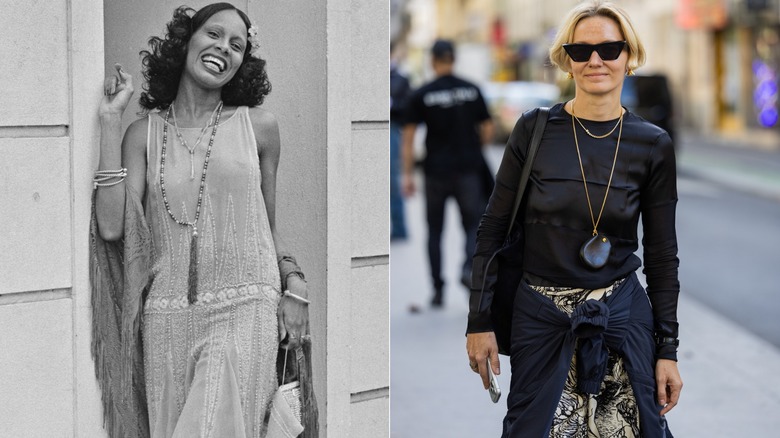
In the 1920s, long necklaces weren't confined to strands of pearls. This was arguably the most definitive accessory trend of the era, and it manifested in a variety of jewelry styles. From pearls to tassels to single statement pendants, long necklaces naturally emerged as a complement to the drop-waist dresses that also dominated the decade. The French sautoir style was the most prominent, featuring a long drop that ended in a pendant or tie-up detail.
This era was dominated by the art deco design aesthetic, so vibrant beaded necklaces were a mainstay, particularly those featuring contrasting color palettes; think black and white or red and green, or maybe a mixture of all four. Beaded necklaces came in both glass and plastic, and were often worn to clash with, rather than complement, an outfit. But beaded or not, long necklaces in the 1920s were worn in layers, just as bracelets were. "In the 1920s, people wanted to turn their backs on the war and indulge in all the pleasures of life," Pierre Rainero explained to Europa Star. "Hence a certain extravagance. Women would wear many bracelets stacked together, and long necklaces."
Fast-forward to 2026, and long necklaces with pendant designs are returning to the fore. These tend to have an artistry to them that sets them apart from generic pendants; designers are showcasing necklaces made with leather and adorning them with unexpected elements, like supersized crystals or small timepieces. Although this is a jewelry trend you could rock all year, it works particularly well for the cold weather, serving as yet another layer in an ensemble of shirts, sweaters, and outerwear. That said, lightweight long cord necklaces can bring the finishing touch to a simple summer outfit just as easily.
Cocktail rings were all about making a statement
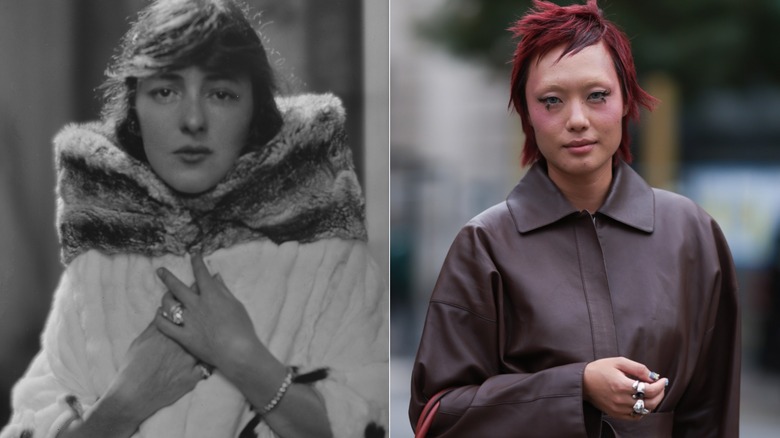
With the art deco movement in full swing, a sense of art and drama extended to all reaches of the jewelry world in the 1920s. Of course, this influenced the most popular styles of rings, which were statement-making and unapologetic. Cocktail rings in particular were a sign of social status and luxury in the roaring '20s, most often consisting of a colored gemstone in the center, bordered by diamonds or even metal wiring. This over-the-top sense of glamour was a product of the decade's prosperity and opulence prior to the Great Depression.
Since diamonds were typically reserved for nighttime events, daytime statement rings in the 1920s usually featured a person's birthstone, surrounded by a filigree design of metalwork. But for day or night, these oversized rings were highly geometric, with everything from rectangular to oval silhouettes in demand.
Statement rings might have fallen below the radar during the early 2020s, when quiet luxury was the style du jour, but we're making room for them again as we head towards the end of the decade. "There's a real appetite for larger rings that double as statement pieces. People want versatility — something that can go from day to night and stand on its own," jewelry designer Roxanne First told Harper's Bazaar in 2026. Rather than boasting the classic cocktail ring halo design, modern statement rings are typically structural and mainly made of gold or silver, though they can still feature big or small gemstones. Otherwise, you can give this vintage trend a modern makeover by choosing a mixed-metal statement ring. Coastal-inspired rings are also having a moment, so now's the perfect time to explore shell designs and the aforementioned pearls.
The Jazz Age or Era of the Tassel?
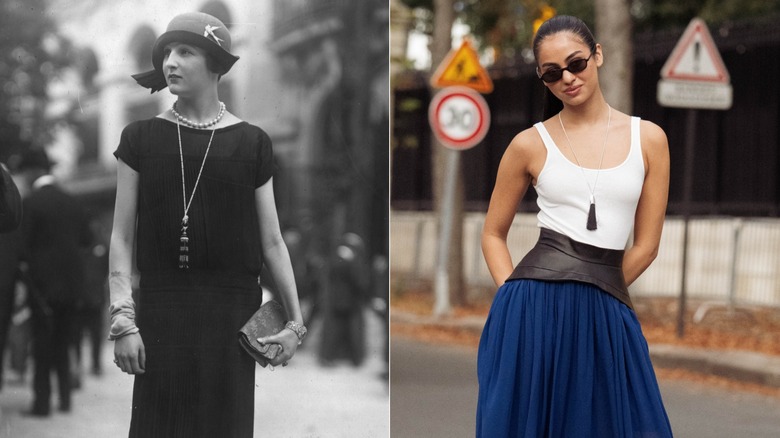
Almost as prominent as pearls and long necklaces in the 1920s was the tassel, and these elements certainly overlapped in the most influential fashion trends of the decade. Tassels absolutely didn't discriminate during this time; they could appear on necklaces but were also widely incorporated into clothes and other accessories. A staple of the standard flapper wardrobe and commonly worn on shoes, handbags, and even dresses, tassels are the perfect accent to reach for if you're trying to model your jewelry today on the styles of a century ago. Of course, you could also just look to current trends for inspo, since tassels are back.
The tassel necklace is still the easiest way to nail this craze in the 2020s, which works well given that longer necklaces are back in fashion, too. Because tassels have an innately bold look (especially if you reach for an oversized statement necklace), they can easily bring a little extra character to understated or minimalist outfits.
Of course, tassel necklaces are just a starting point. Tassel earrings are also popular in the 2020s and can add a sense of fun and drama to a formal outfit — double the points if you wear them with an updo or a low neckline. Even bracelets with tasseled details work well and are ideal for those who want to pull off the trend in a more unexpected way. Along with the old-school fashion trends from the 1920s that are making a comeback in modern times, jewelry styles like this can create a look that transcends decades.